MEP, renovation and maintenance for hotels and hospitals · Riyadh, working across the Kingdom
We upgrade hotels and hospitals while they stay open
MEP (mechanical, electrical and plumbing) upgrades, brand conversions and maintenance for owners and operators in Saudi Arabia. In a hotel, work runs floor by floor so most rooms keep selling; in a hospital, every works zone is contained and agreed with the clinical teams. Any shutdown is agreed with you in writing first.
Site visit: a walk-round with your chief engineer and a short scope note. Assessment: a full condition report and CapEx plan, at a fee confirmed in writing first.
Guest rooms stay cool while the plant on the roof is replaced.
How we do it
Chillers are replaced one at a time in the lower-load months (November to March in Riyadh), on lift dates chosen from your occupancy forecast, away from Riyadh Season peaks and major events. Where the remaining chillers can carry the load, they do; where they can't, we bring in temporary cooling for each swap, as the survey will have shown before you approve the budget. Each swap is a single planned crane lift, booked as an exception to the quiet hours and agreed with the general manager two weeks ahead. The new unit is commissioned and run with the others before the next one comes out.
Most rooms keep selling, and every floor has a date to come back on sale.
How we do it
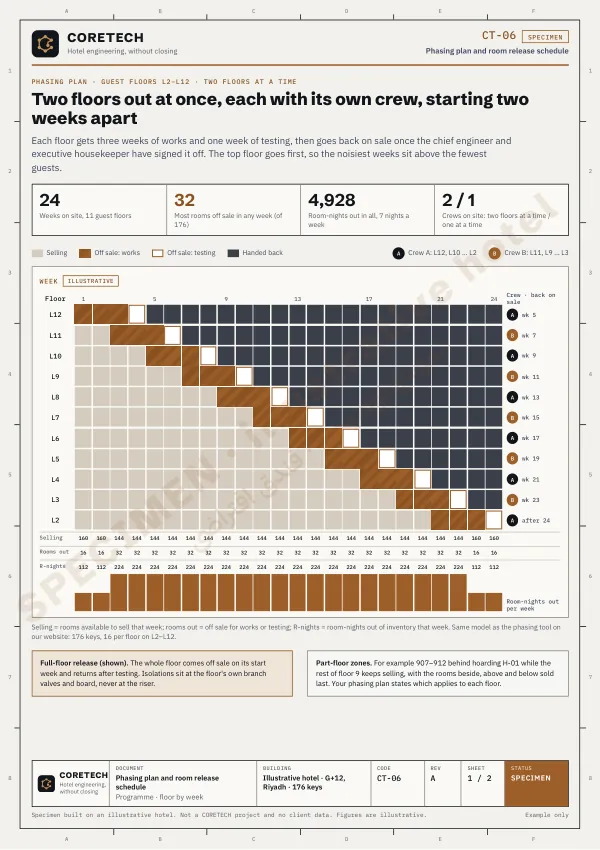
In the example below two floors are off sale at once, each with its own crew, starting two weeks apart and working down the building. Each floor is isolated at its own floor board and at the valves that serve its rooms: the floor's branch valves where pipes run along the corridor, or each fan coil's own valves where the coils are fed straight from vertical risers, so the risers stay live for the floors above and below. Then it is upgraded, tested and handed back to housekeeping. Prefer one floor at a time? The programme takes longer, and the slider shows by how much.
Fire and life safety, tested before the Civil Defense inspection
Ready for the Civil Defense inspection and your Salamah safety licence renewal, with the test records to show it.
How we do it
Your main switchboard and generator, and the supply capacity your Saudi Electricity Company (SEC) connection allows, are checked against your summer peak before anything new is sized. Fire pumps, sprinklers and alarms are installed only by Civil Defense-licensed contractors under our supervision, to drawings approved by Civil Defense, and tested in front of you. Where guests complain of weak showers, we start at the tanks, the booster set and the pressure-reducing valves.
Handed back with the paperwork your engineers need
A building your engineers can run from day one.
Test records, as-built drawings and operation and maintenance (O&M) manuals for every system in the scope, and a taking-over certificate for each zone. Then, if you want us to, we stay on to maintain it.
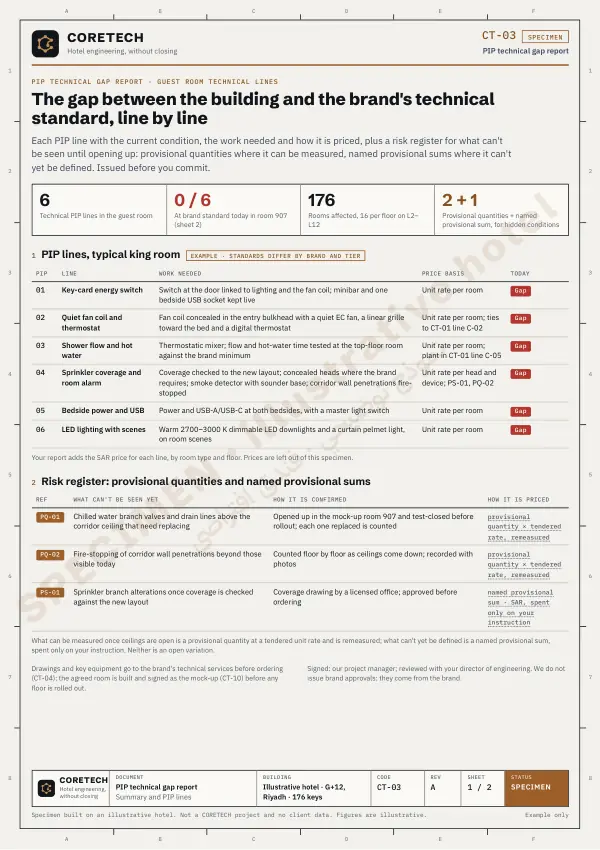
The technical items in the brand's property improvement plan (PIP) are closed and evidenced before the inspector arrives. The result is the brand's decision.
A hotel can't close for six months so a contractor can work.
This work happens in buildings with guests upstairs, a wedding in the ballroom and an operator checking occupancy every morning.
Our specialism is hotels of 50 to 200 rooms that need work done without closing. Larger properties are scoped case by case, phased by wing or stack as well as by floor.
Hospitals and clinics are the same problem with higher stakes: patients can't be moved like guests, and some systems keep people alive. We bring the same method there, with infection control containment before any works. How we work in an occupied hospital
The people behind CORETECH come from hotel operations, so we plan engineering work the way a general manager would: around arrivals, events and housekeeping, with noisy work kept to agreed hours and a front office that knows what to tell a guest before the guest asks. We work to the Saudi Building Code (SBC) and Civil Defense requirements, with design by licensed engineering offices where a stamped design is needed.
Assess, upgrade, run
The work can be one chiller or a full brand conversion (re-flag). It always starts with a survey of the building as it stands.
Step one · fixed fee
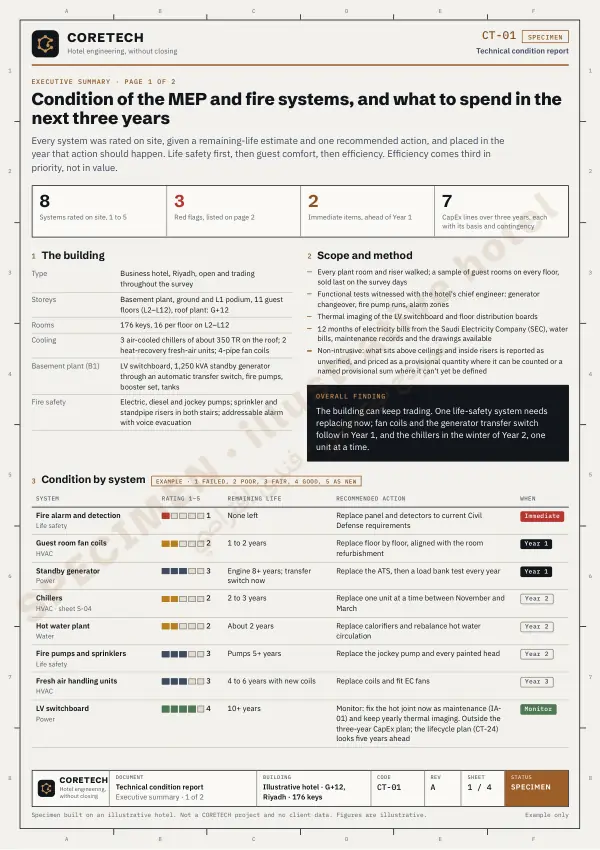
Hotel Technical Assessment (CT-01)
You get a condition report and a CapEx plan you can approve, price and share with any contractor.
We survey the building as it stands, rate each system and price what needs doing, with the basis and contingency on every line. The fee is quoted before we visit and is separate from any works.
How eleven guest floors are refurbished while the hotel stays open
Move through an example programme, choose one or two floors at a time and put in your own room rate, occupancy and high-demand nights. Two floors at a time finishes 20 weeks sooner; one floor at a time keeps 160 rooms selling instead of 144. Your revenue manager picks the mix in CT-06, the phasing plan.
What changes the cost is when the works fall. Your phasing plan puts the heaviest weeks where your forecast is lowest, agreed with your revenue manager around Ramadan and Eid, Riyadh Season and the conference weeks when the city sells out.
Crews on site:2
Rooms selling
144of 176
Off sale (works + testing)
32rooms
Of those selling, sold last
32rooms
Room-nights off sale to date
1,792of 4,928
Absorbed by rooms still selling
1,556of 4,280
Displaced on high-demand nightsDisplaced on high-demand and busy nights
236of 648 room-nights
SAR 106,047of 291,630
Floors finished
3of 11
Worst case (every night full), SAR
2,217,600whole programme
Two floors at a time finishes 20 weeks sooner; one floor at a time keeps 160 rooms selling instead of 144. Your revenue manager picks the mix in CT-06, the phasing plan.
Selling
Sold last (next to works)
Works
Testing and commissioning
Handed back
Two weeks late (example)
Selected week
Two ways to phase.Full-floor release when the work reaches the riser branches, ceilings or bathrooms below: faster and cleaner, and the mode this example shows. Part-floor zones behind a sealed hoarding when the work stays inside the rooms, such as a soft refresh, a fan coil swap or a rewire: more rooms keep selling, but it runs longer. Your phasing plan states which applies to each floor.
Sold last. Rooms on the floors directly above and below a floor in works stay in inventory and are sold only when the hotel is near full, so most of them still earn. The tool counts them as rooms still selling.
A room off sale costs money only on nights the hotel would otherwise have filled it. That is why we plan the heaviest weeks into your lowest forecast.
How the figures are worked out: each night, demand is your occupancy × 176 rooms, or all 176 on a high-demand night. Displaced room-nights are the demand above the rooms still selling; each is valued at your room rate. High-demand nights are spread evenly through the year (4 a month is 48 a year). With two floors out, 144 rooms still sell, so an ordinary night loses nothing until occupancy passes about 82%; with one floor out, about 91%. The worst case assumes every night is full, so every room-night off sale is a sale lost at your room rate. The figures leave out the higher rate after refurbishment and any food and beverage spend.
The reference hotel has ground plus 12 floors, with 11 guest floors of 16 rooms (176 rooms). Three weeks of works per floor includes bathroom wet works with a flood test before tiling, and assumes no tub-to-shower change. Drains are reached from the works floor; where a drain can only be reached from the ceiling below, that ceiling is opened in the same phase, with the rooms under it held off sale for those nights. Real phasing depends on the building, the scope and your occupancy forecast.
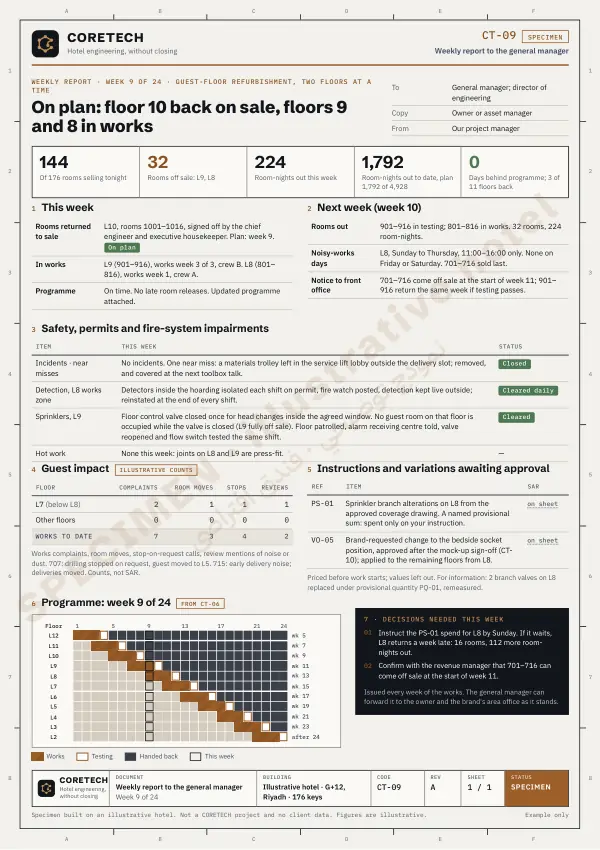
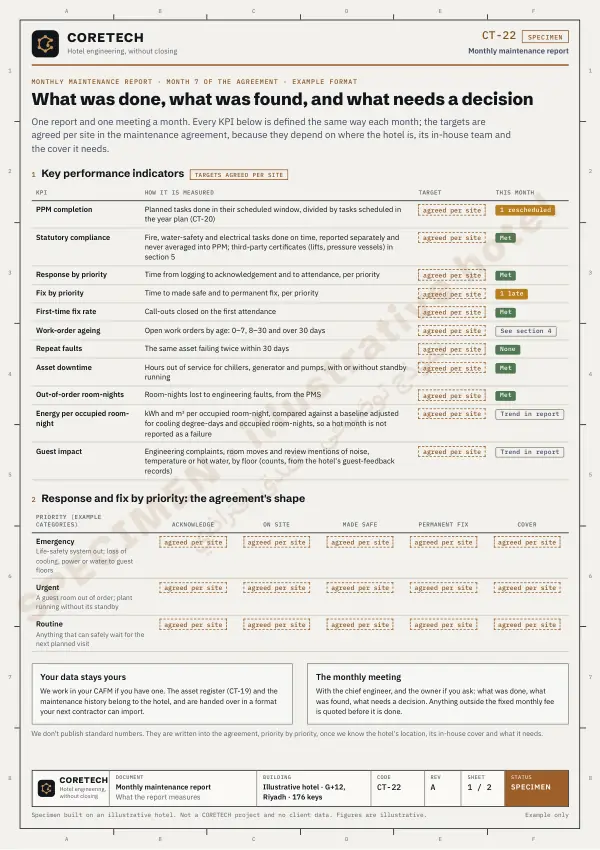
Our paperwork is the clearest proof of how we work. Each document carries a CT number from our document register. Open a specimen page from five of them, each built on the same 176-room reference hotel. Every engagement is contracted to end in documents your asset manager, your operator and your lender can use.
Specimen pages on the reference hotel. Your documents carry your building's findings and figures.
Sample report pack
The pages a board or investment committee reads
A two-page executive summary, a CapEx table with basis and contingency, one system sheet, the phasing plan (CT-06) and a weekly report (CT-09), as one PDF on the same reference hotel. Tell us who you are and we will send it.